
To assess Social-Ecological Resilience (SER), SECORES chose to work with the SEPLS methodology: Indicators for Social-Ecological Production Landscapes and Seascapes. In a webinar on 21 April 2026 recent experiences were explained and commented.
After a general introduction on the methodology itself and what has been done by SECORES in previous years, 3 experiences were shared: (a) testing SEPLS in a pilot project in Senegal (2025); (b) linking the Senegal results to the first test in Burundi; and (c) using SEPLS in measuring the outcome indicator on resilience in the 5-year program of Join For Water.
The overall conclusions of the webinar are
- experiences show that the SEPLS tool is participatory, practical, usable and flexible. The data are mainly qualitative and help stakeholders (and communities in particular) to understand and appreciate the resilience of their social-ecological system;
- however, time must be invested in adapting the tool to the local context, explaining the concepts, translating them into the local language and triangulating the results.
APEFE and UCOOPIA explained how they tested SEPLS in Palmarin Community Nature Reserve in the Sine-Saloum Delta in Senegal. This is a complex area featuring mangroves and human activities with high pressures.
Some lessons of this pilot project
- Methodological precautions
- The data are partly subjective: results vary depending on who participates, the dynamics of the discussion, etc.
- Inter-village comparability is only valid if the same survey procedures are applied.
- Charts describing configuration of resilience are to be used to prioritise and discuss but they must not be seen as performance scores.
- SEPLS shows plausible relationships but not causal evidence.
- Triangulation between workshops, surveys, interviews and observations must be cross-referenced before decisions are made.
- Benefits of the SEPLS methodology
- It provides a common language for multiple stakeholders and an integrated perspective. SEPLS is therefore a tool for analysis and dialogue to support collective decision-making.
- The tool makes compromises and tensions visible and facilitates prioritisation.
- Care must be taken to ensure clear objectives, contextualised indicators, and appropriate facilitation and reporting.
- However: knowledge of social-ecological resilience and the SEPLS tool is very limited, if not non-existent. Therefore, ample time must be set aside to explain everything and adapt it properly to the local context. This cannot be done in a single session; explanations and improvements to the methodology must therefore be revisited on several occasions.
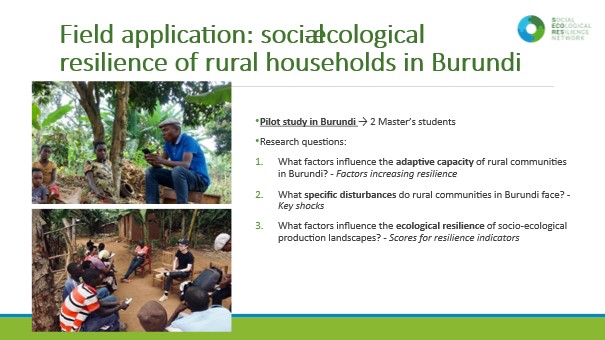
Prof. Jacques Nkengurutse of the University of Burundi confirmed the outputs of the Senegal study based on the first field study in three agroecological zones in Burundi using surveys and focus groups.
- The added value of the SEPLS method
- A suitable framework for a preliminary assessment of social-ecological resilience in a development context
- A rapid method (1.5 days) in regions with limited data and financial constraints
- Suitable for community engagement, based on participation
- The scores assigned during the workshop should not be considered quantitative data, but rather a summary of the preliminary assessment.
- Additional data may be required (e.g. via a questionnaire).
- Discussions are essential and lead to the identification of improvement strategies.
- Results are easy to visualise.
- Limitations and challenges
- Scores are based on participants’ perceptions. There is variability depending on profiles. Scores are not quantitative data. There are difficulties in understanding and translating concepts (into the local language).
- Although the tool is relatively quick, it still takes significant time (from a few hours to two days). And there are logistical costs.
Join For Water explained the experience of measuring SER in its 2022–2026 programme. An indicator firstly intended to use outcome mapping to measure it based on the DPSIR method. However, the resulting information was too limited, focusing on activities rather than strategic changes. To measure the value in year 3, testimonials were collected from stakeholders relating to the five pathways of change in SEPLS. The format for collection was open-ended, and the information was categorised retrospectively according to the five pathways of change.
The lessons were: (a) adapting the method to the local context is good, but a basic standard framework is necessary. It is therefore important to collect information on the five pathways of change. (b) To compare baseline and follow-up data, the same process must be used and the same group included. (c) It is essential to fully understand what is being discussed. (d) Not all changes are of equal importance. (e) Collecting stories helps to understand the changes. (f) Break down the changes by group where possible. (g) The work must be representative in terms of the type of stakeholders and the number of people interviewed. (h) As far as possible, the results of the exercise should be triangulated with other sources. (i) The SEPLS is therefore indicative (the results indicate where more effort is needed) and educational (the results help to understand and analyse, and this enables capitalisation and dissemination).
To measure the indicator at the end of the programme, it was decided – based on these lessons – to analyse the five pathways for change using specific questions tailored to Join For Water’s strategies. The approach should be adapted to the local context, but there are clearer guidelines for organising participatory workshops based on the ‘SEPLS Toolkit’. The five pathways of change in SEPLS have also been translated into five questions in the water sector.