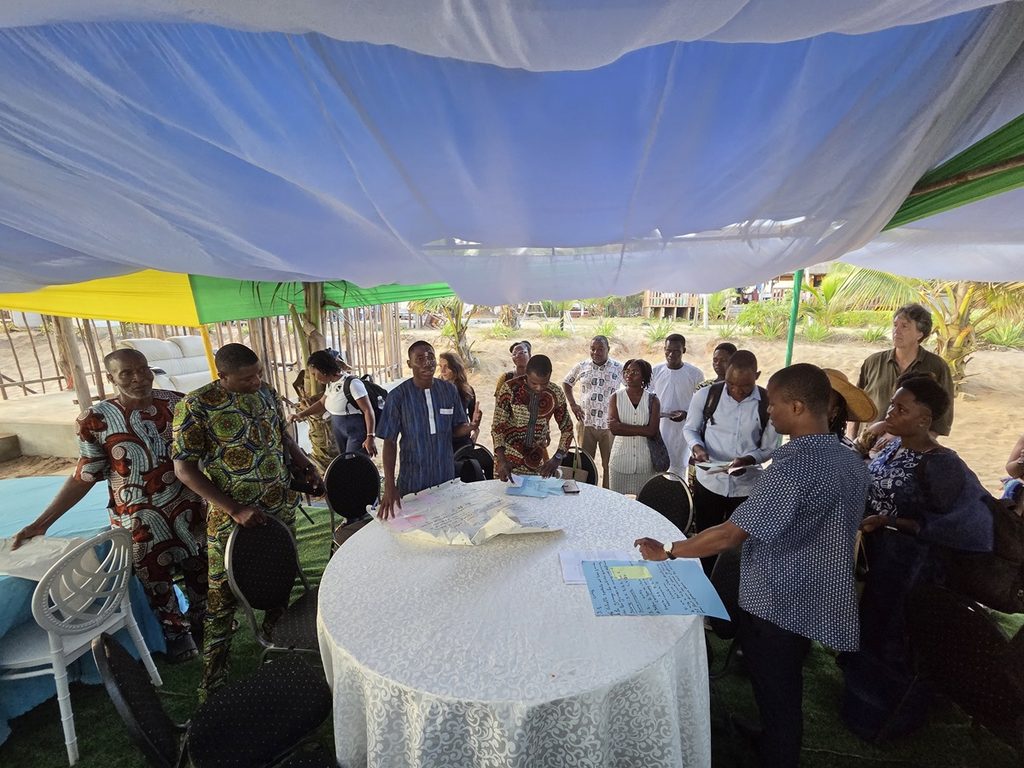
From 23 till 27 September 2026, the second Mangal Festival took place in Grand Popo, Benin (the first edition was in Senegal in 2023). The festival itself was the climax of a trajectory of several months around 5 programmes on (a) pedagogy and education; (b) management of protected areas; (c) science; (d) arts and culture; and (e) territorial attractiveness. The festival included scientific presentations, debates, artistic activities, etc. Click here for more info.
SECORES organized two side events on Social-Ecological Resilience (SER) and its link to mangroves. Both were facilitated by Constant Setonde Gnansounou who made his PhD on SER in mangroves.
Side-event 1: experiences of SER in mangroves
For several years, Action Plus, CAPEBIO, CEBioS, CREDEL, Eco-Bénin, Louvain Coopération, Join For Water, and ODDB have been supporting mangrove communities in Benin in improving their SER. In this workshop, NGOs and community representatives shared their experiences and answered questions from practitioners and other interested parties.
After a short introduction on SECORES and the 4 axes necessary to work on SER, a video showed how this is applied in mangroves in Benin. Four representatives of the local communities and authorities explained their experience with SER. The following topics were further discussed with participants.
- How to improve solar salt production on tarpaulins? The produce large crystals that were difficult to market initially, but which, following adjustments, were successfully brought to market. This approach enables a move towards zero felling: it is the only initiative that completely eliminates mangrove felling. Furthermore, many mangroves are considered sacred.
- Alternative sources of income must be made available to young people, as they are primarily the ones cutting down the mangroves.
- Day-to-day support and awareness-raising are always in demand.
- There is a need for genuine support from the authorities to preserve these ecosystems.
- Restoration cannot been done against the will of the community. Mangroves enable the local community to survive. They protect them for our own sake, not for the authorities.
- Site selection and hydrological conditions will facilitate the dispersal of propagules and ensure permanent access to water.
- Is there any reward mechanism to motivate women to make greater efforts towards conservation?

Side-event 2: assessing the resilience of social-ecological system in mangroves
SECORES considers the SEPLS methodology useful and practical to assess SER. The objective of this interactive session was to show how SEPLS works and to let the participants have a taste of some elements of the methodology.
After an introduction of the SEPLS methodology and the experiences of SECORES till now, some elements were discussed by participants based on the concrete case of the Bouche du Roy in Benin. Since SEPLS contains 5 main areas and a total of 20 indicators, the audience was split up in small groups discussing each one indicator linked to one main area. At the end, each table gave a short feedback.
- Area 1: Landscape diversity and ecosystem integrity; indicator 3: Ecological vulnerability and resilience
- Area 2: Biodiversity and sustainable management; indicator 4: Diversity of species with which communities actively interact
- Area 3: Knowledge integration and transfer; indicator 5: Promotion and integration of traditional knowledge
- Area 4: Livelihoods and well-being; Indicator 7: Income diversification and sustainability of biodiversity-based livelihoods
- Area 5: Governance and social equity; Blanche Indicator 9: Degree of co-management of terrestrial/marine landscapes
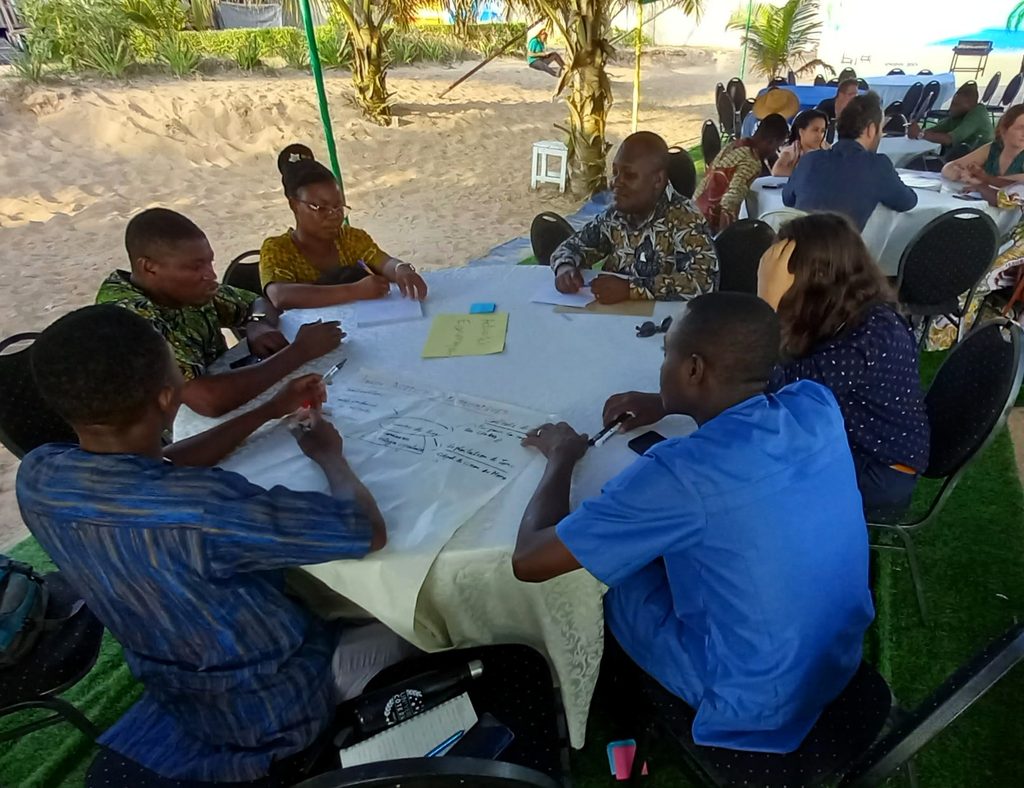
The round-table discussions were, on the whole, very positive; participants quickly got into the swing of things and contributed well. Each group explained their scoring and the main points of discussion, as well as their overall view of the method. Feedback on the method was generally positive, despite a few comments about the vagueness of certain questions, which are difficult to elaborate on in such a short space of time. Overall, it provided a good practical insight into the method.